Arraial 1.0.0-beta.1: politics, eras, festas and the code on GitHub
Arraial, my Minecraft mod, has grown: it's now 1.0.0-beta.1, with 16 trades, politics, eras, festas, diplomacy between villages, and the code is on GitHub.
- #minecraft
- #mod
- #fabric
- #java
- #arraial
- #gamedev
- #github
In the last post I introduced Arraial, my Minecraft mod where villagers build the village on their own. Back then it had a mason, a handful of trades and a mayor.
Since then, the mod has grown a lot. It went from version 0.1.0 to 1.0.0-beta.1, and the code is now public on GitHub:
The new description sums up what it has become:
Brazilian colonial villages that build and run themselves.
The inspirations
Arraial has two references, and they're written right in the mod's design document:
- Millénaire, for its autonomous villages that live and grow without depending on the player.
- MineColonies, for managing a settlement with citizens and professions.
Everything in Arraial is original: code, textures, models and buildings. Nothing was copied from those mods.
The other inspiration is Brazil itself. Many of our towns started as an arraial around a cross or a chapel and grew house by house. The mod starts from that idea and goes further: villages that produce, trade, throw festas, vote and fight over land.
What changed since the last post
16 trades
There used to be 8. Now there are 16, each with its own workstation: mason, woodcutter, farmer, potter, clay digger, quarryman, herder (vaqueiro), fisherman, hunter, flour maker, market vendor, muleteer (tropeiro), apothecary, soldier, engineer and public relations.
The engineer builds streets, bridges and lamp posts. The flour maker runs the Flour Oven: cassava becomes flour, beiju and paçoca, which finally fixed food shortages in the villages.
Villagers who look like people
The skins were redone from scratch, with varied faces (eyebrows, mustaches, beards, elderly people), hairstyles (buns, braids, curls, headscarves), clothes marked by each trade and 6 looks. Children take after one of their parents.
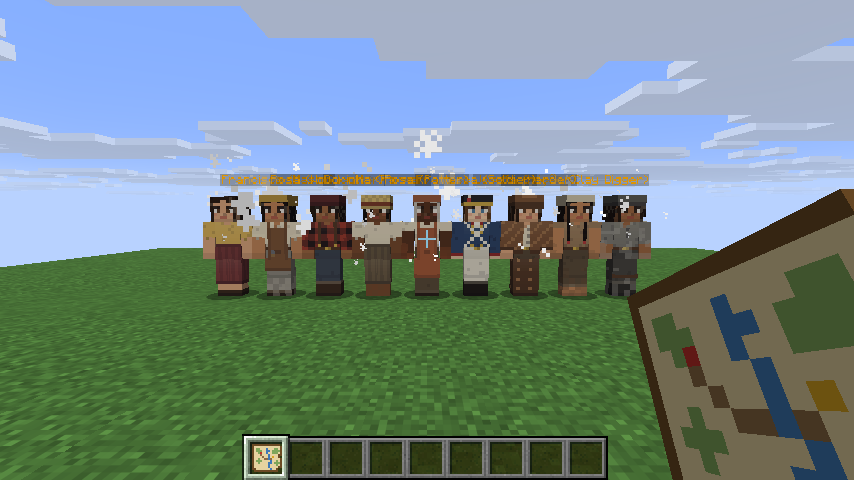
And yes, there are children now. Villagers have personalities, needs, friendships, rivalries and dreams. They get married, their kids grow up and there's inheritance.
From mud walls to whitewash: three eras
The village grows through stages (Povoado → Arraial → Vila → Prosperous Vila → Cidade) and goes through three eras of architecture:
- Colonial: wattle and daub.
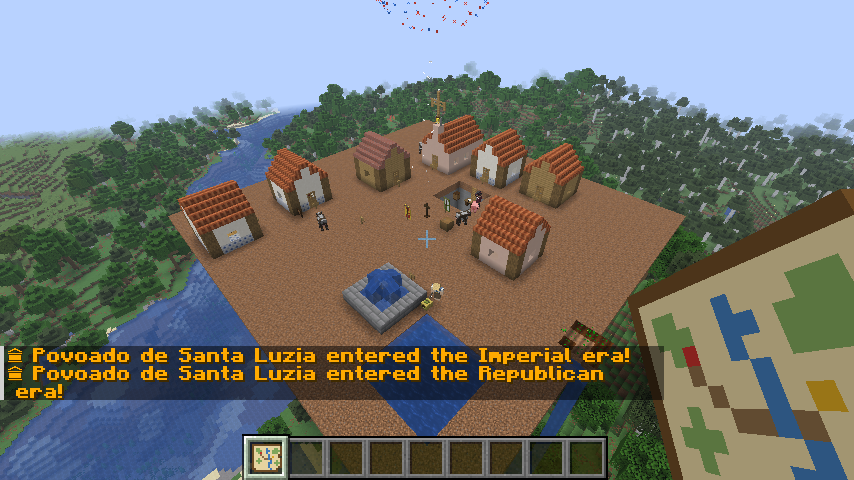
- Imperial: brick and clay roof tiles.
- Republican: whitewash and azulejo tiles.
In each era, houses and streets are reformed in the new style, and a Chapel and a Fountain appear. For that, the mod got its own colonial blocks: Wattle and Daub, Clay Roof Tiles, whitewash and Azulejo Tiles.
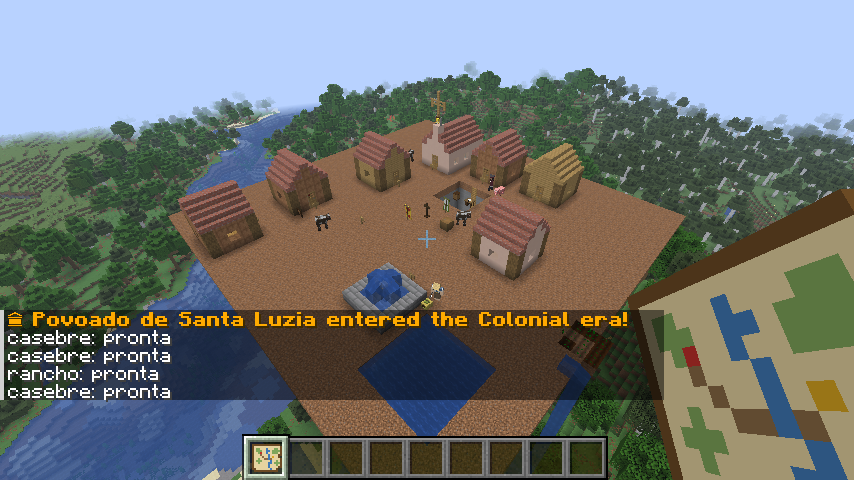
Compare it with the image at the top: it's the same village, in the same spot, before and after going through the eras.
A real economy, with réis
- Réis as currency, minted in the game.
- A Market Stall with supply-and-demand prices.
- Peddlers who visit the village, muleteers running caravans between villages (you can escort them), orders, supply contracts and beaten roads that make transport cheaper.
- Regional prices: a neighbor with plenty makes things cheaper, a closed route makes them pricier.
Calendar and festas
The year has 12 months of 2 days each, with a dry season and a rainy season. The calendar includes São João (Saint John's festival, with bonfire and quadrilha dance), the patron saint procession, the Great Fair with discounts and each village's own traditions. At the festa there's quentão (hot spiced drink), pé-de-moleque (peanut brittle) and paper bunting.
Crises
Drought, flood, pests, highwaymen, epidemics (with an apothecary) and fire, each with its own response.
Politics
This part turned out very Brazilian. The village has a council with representatives of each group, voted proposals (taxes, works, security), corruption and investigations, protests and even hereditary coronelismo (rule by local strongmen). The player can support and propose, and can be voted down.
A world that lives without you
Neighboring villages are founded and grow on their own, even far from the player. They produce, go hungry, migrate, trade, go to war and can turn into ruins taken over by bandits. That includes your own base, if you abandon it.
Territory and diplomacy
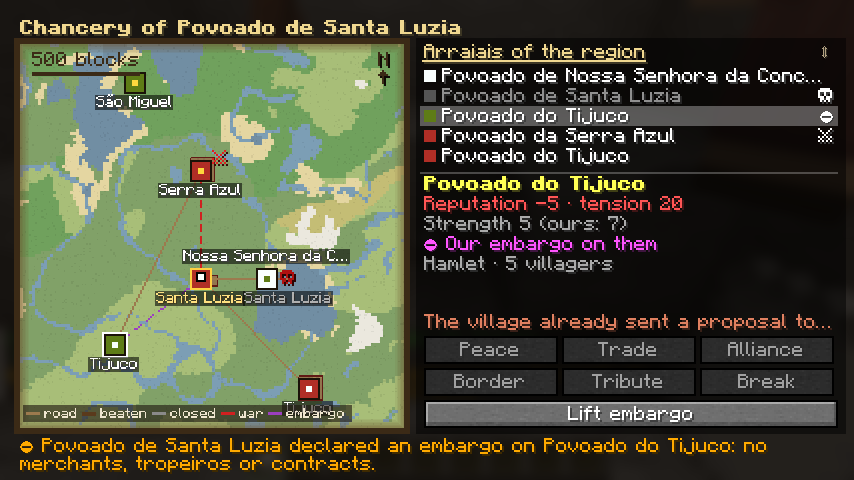
Borders are per chunk, with a Boundary Stone, disputes that have causes, war and peace with tribute. At the Chancery you see the Regional Map, propose peace, trade and alliances, demand tribute and declare embargoes.
Items and the Arraial Guide
New items: machete, peixeira (a long fish knife), a sickle that harvests 3x3, the vaqueiro leather set (jacket, leggings, sandals and hat), a flask, rapadura (raw cane sugar), a gourd of sugarcane juice, an oil lamp… The 3D models were made in Blockbench. There are also 19 advancements and optional JEI integration.
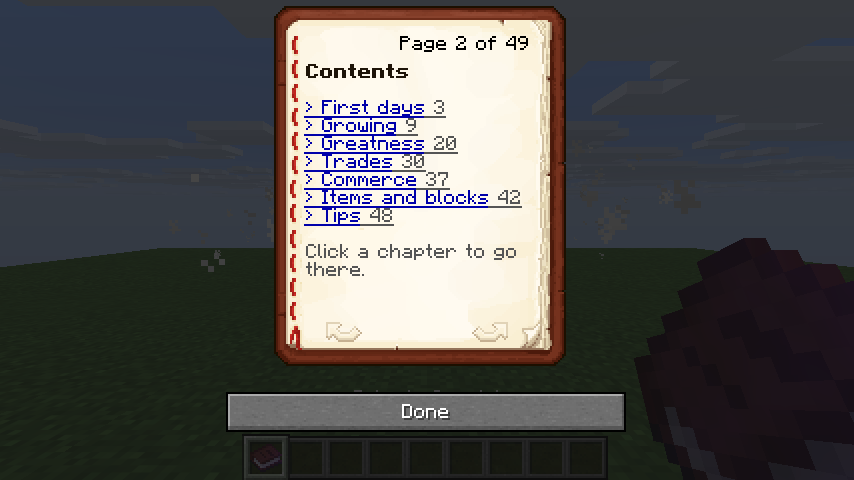
So nobody gets lost, the mod ships with the Arraial Guide: a 49-page in-game manual with a clickable table of contents.
Automated tests inside Minecraft
With so many new systems, the mod also got an automated test script: with the ARRAIAL_ROTEIRO=1 variable, it runs inside the game client, goes through politics, quests, territory, families, eras, the chancery, the map and the blocks, and takes screenshots of each step.
The script is kept out of the public .jar. Anyone who downloads the mod loads none of it.
Where it stands
- Version: 1.0.0-beta.1, built with Fabric for Minecraft 26.3, in Java 25.
- Code: public on GitHub, with automated builds, a contributing guide and issue templates.
- Download: there's no published version to download yet. Official pages on Modrinth and CurseForge are coming soon.
- Testing: the automated script covers a good part of the systems, but a lot of the new stuff still needs to be actually played to be balanced.
About the license: the code is public to read and contribute to, but all rights are reserved. You can play it, use it on servers, include it in modpacks (downloaded from an official page) and make videos and streams, monetized too. Reuploading it elsewhere, selling it or publishing modified versions requires permission.
Want to help?
If you play modded Minecraft, take a look at the repository. Bugs and suggestions go in the GitHub issues. And if you have an idea for a trade, festa or building that would fit an arraial, let me know.
Follow the development
I also post video content over there. Follow along:
- YouTube: @dev.gui01
- TikTok: @dev.gui1
See you in the next one. ⛏️