Ironhex: recruit, deploy, win. Meet my military auto battler
Introducing Ironhex, my military auto battler on a hex board, made in Unity: how a match works, what makes it different and where it stands.
- #gamedev
- #unity
- #ironhex
- #indie
- #auto battler
Yesterday I introduced Oxe, Meu Bar!, my beach bar management game. Today it's the turn of the other project that's been eating my nights: Ironhex.
If Oxe is about cold beer and Carnival, Ironhex goes the opposite way: sandbags, trenches, artillery and a board made of hexagons.
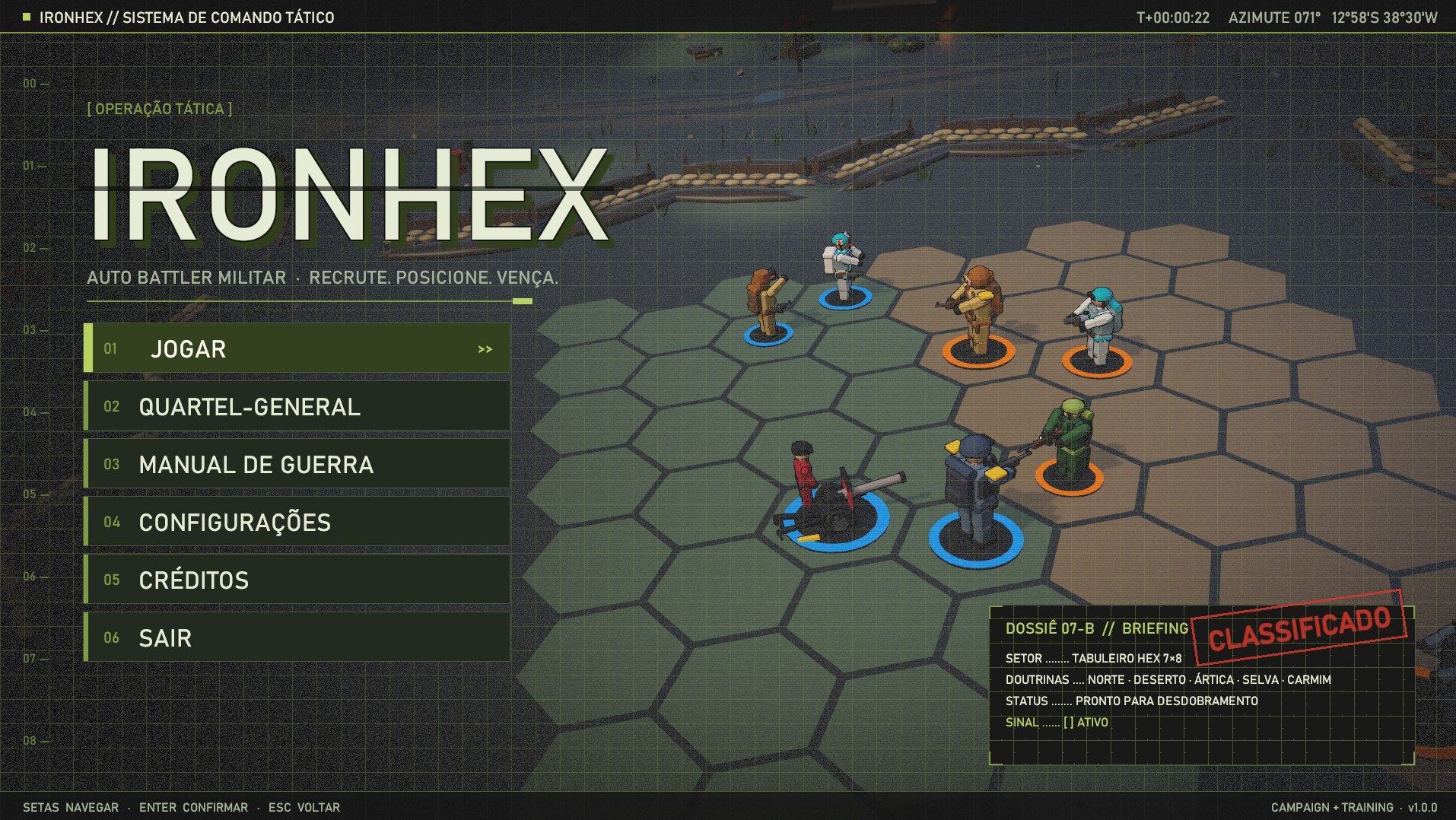
The main menu. The idea was for it to look like a tactical command terminal, with coordinates, azimuth and a "classified" dossier in the corner. (The screenshots are from the Portuguese version; the game is also in English.)
What Ironhex is
Ironhex is a military auto battler for PC. If you've played Teamfight Tactics or Auto Chess, you know the genre: you don't control the units during the fight. You recruit, combine and position them, and the battle plays out on its own.
The tagline on the menu sums it up: recruit, deploy, win.
Every match has 8 commanders with 100 Morale (that's your health). Lose a fight and you lose Morale, hit zero and you're out, and the last one standing wins. In Early Access you play against 7 bots, and a match takes about 30 minutes.
It's made in Unity 6, with low-poly 3D visuals and a UI that looks like a military panel: olive green, condensed type and stencil.
What a round looks like
Every round has two phases:
- Planning (30 s): you get Supplies (the in-game currency), buy troops in the shop, rank up and arrange your platoon on the board.
- Combat (up to 30 s): the simulation runs by itself. You just watch and hope.
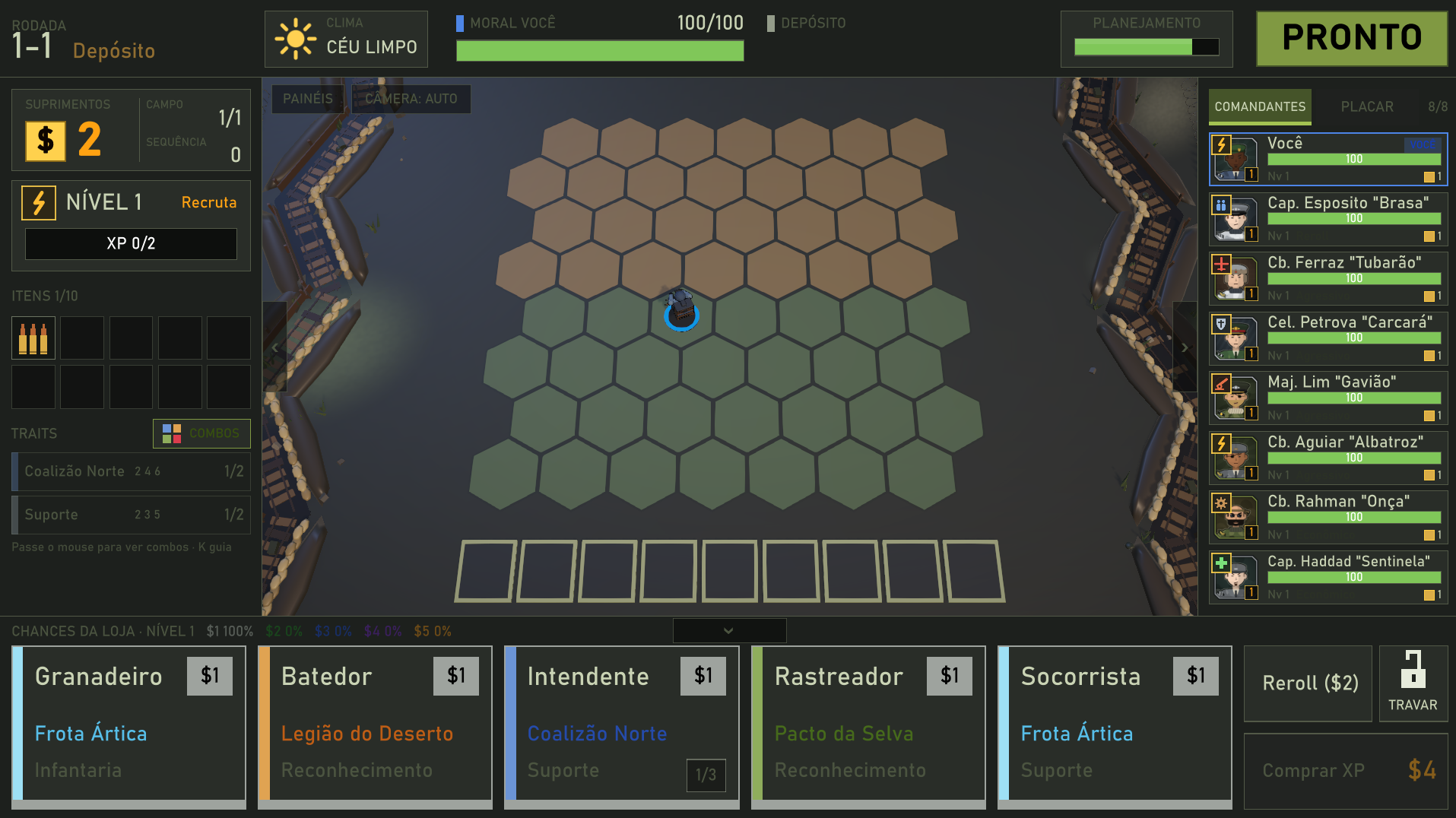
Round 1-1. On the left, Supplies, rank, items and traits. On the right, the 8 commanders. At the bottom, the shop.
The shop shows 5 units at a time. You can spend 2 Supplies to refresh the cards (the classic reroll), lock the shop to keep a card for later, or buy XP to rank up faster.
And the ranks are literally military: you start as Recruit and climb through Private, Corporal, Sergeant, Lieutenant, all the way to Marshal. The higher your rank, the more units you can field and the pricier (and stronger) the troops that show up in the shop.
Combining troops: the heart of the genre
Three copies of the same unit become a ★2 version. Three ★2s become a ★3, which is a lot stronger. The shop tells you when you're close: in the picture below, the Herbalist shows the PROMOTES x2 badge, because buying it completes the combo.
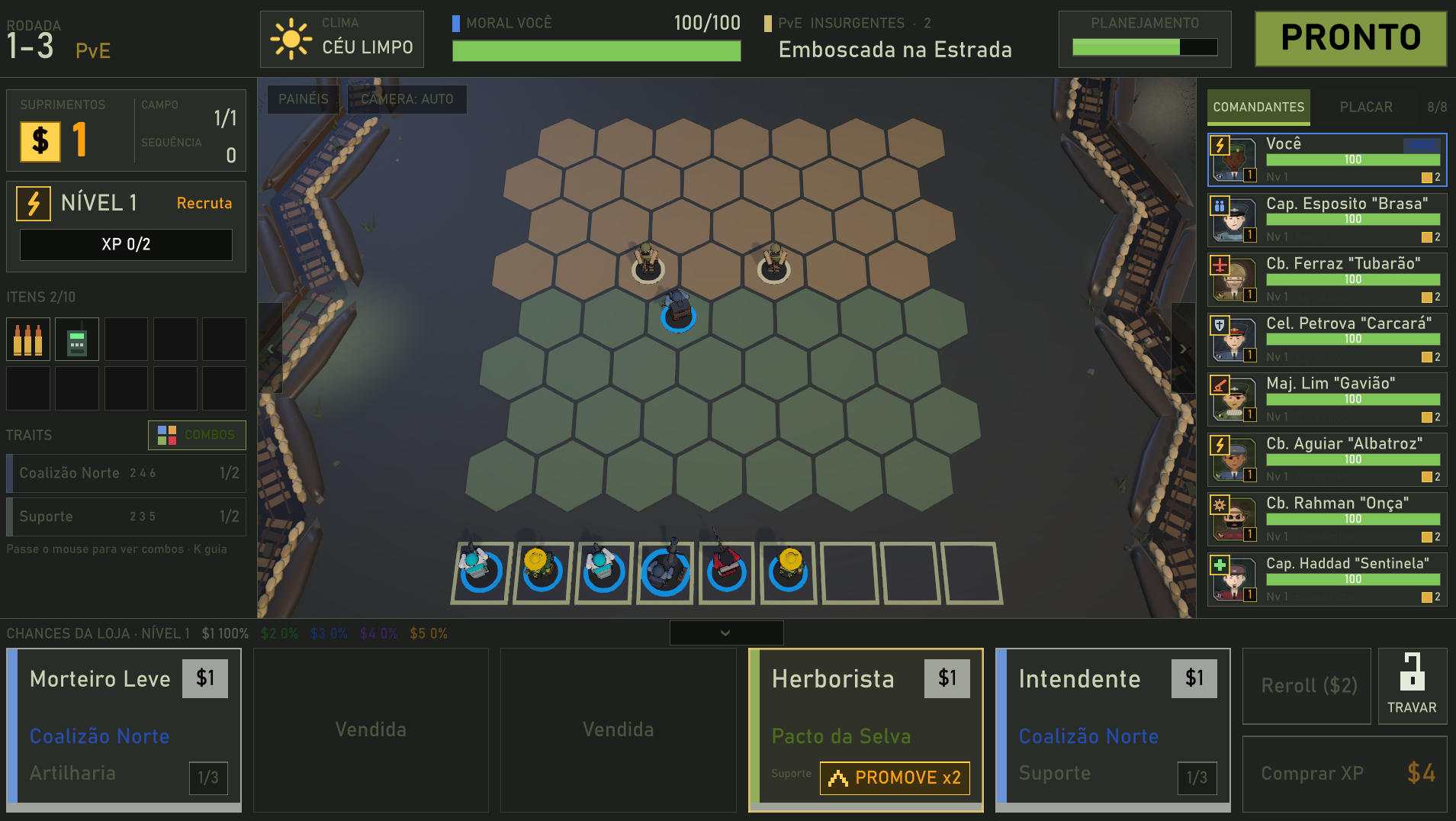
Bought the Herbalist, got the promotion. The reserve bench under the board has 9 slots.
Doctrines and Roles
Every unit has a Doctrine, its fictional nation, and a Role, its job on the field. Fielding different units from the same Doctrine or Role unlocks bonuses for the whole team.
There are five Doctrines, each with its own personality:
- Northern Coalition: discipline and firepower, gains armor.
- Desert Legion: guerrilla and mobility, gets faster with every kill.
- Arctic Fleet: technology and sustain, starts the fight with shields.
- Jungle Pact and Crimson Regime, which came later and round out the cast.
The Roles are Infantry, Artillery, Recon, Armor and Support. There are 36 units today, from Rifleman and Medic up to Heavy Tank, Attack Helicopter and Missile Battery.
When the fighting starts
Early in the match there are PvE rounds against Insurgents, weaker neutral enemies that drop supplies and items. After that come the PvP rounds against the other commanders.
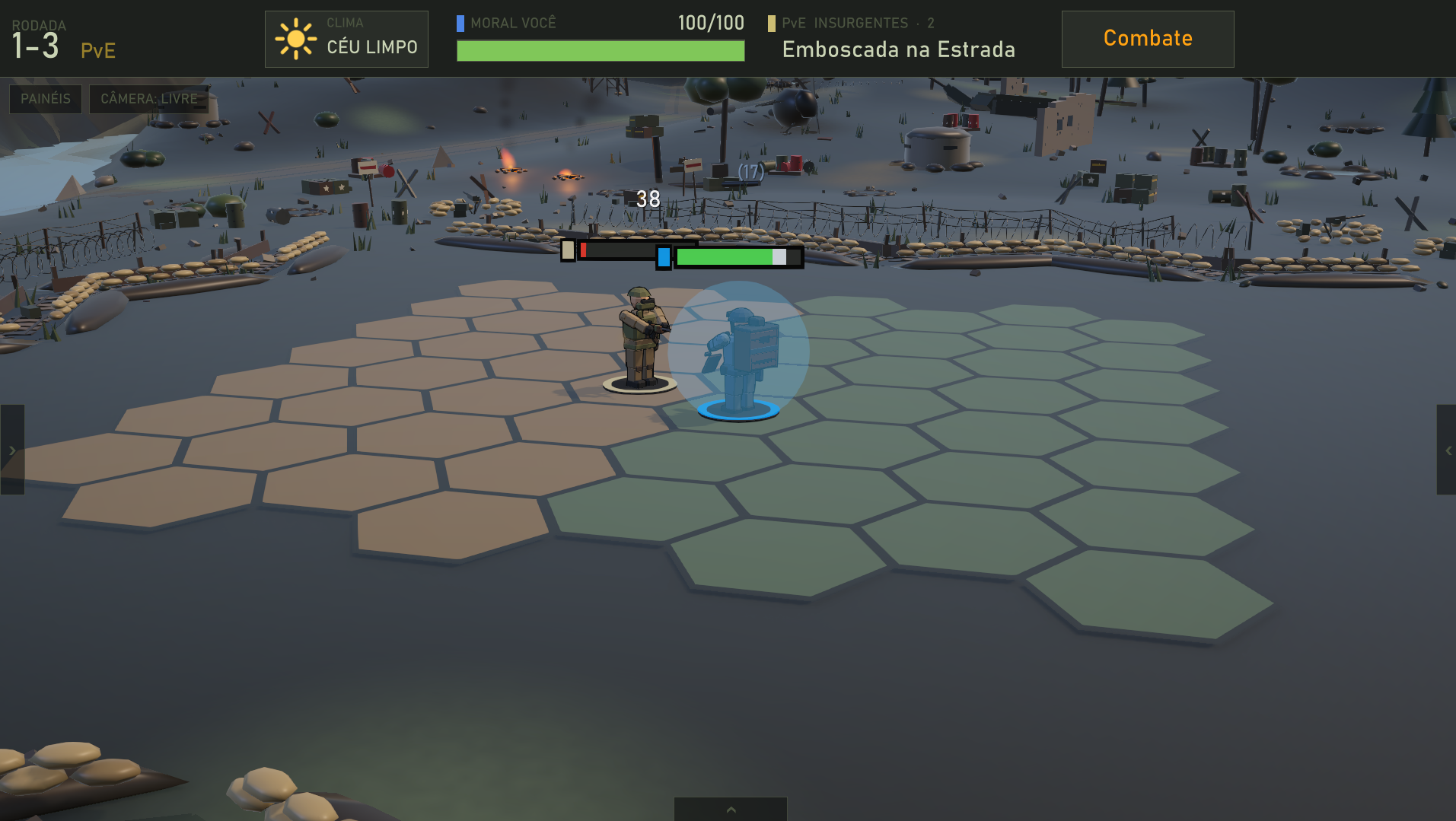
Round 1-3, "Road Ambush". Here the camera is in free mode, so you can see the whole scenery around the board: trenches, barbed wire, a bunker and campfires.
The camera has two modes: automatic, which frames the board from above, and free, so you can rotate and get close to the action.
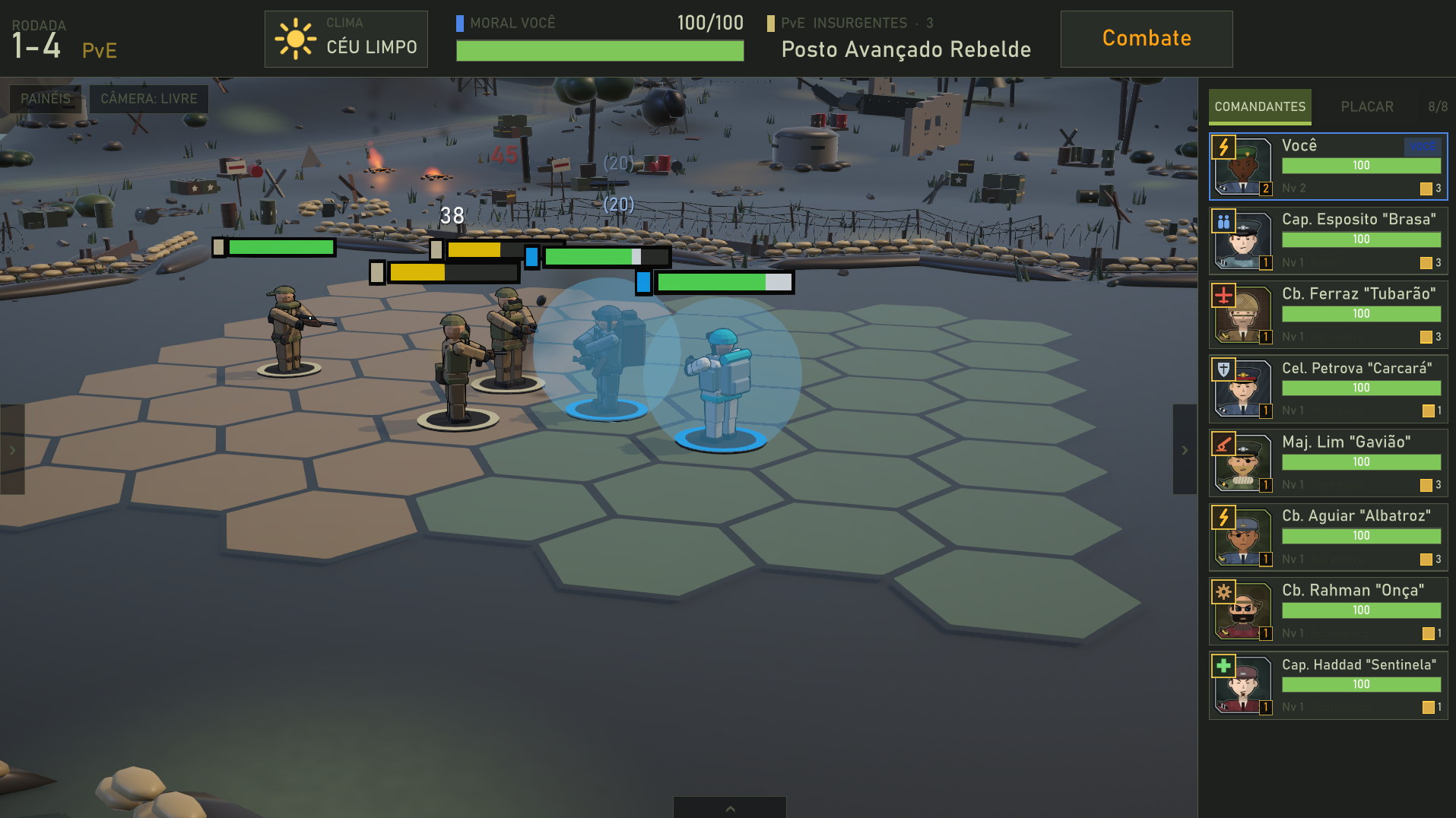
Round 1-4, "Rebel Outpost". The floating numbers are the damage of each hit, and the blue bubbles are the Arctic Fleet's shields.
What makes Ironhex different
Genre mechanics are free for everyone, so the shop, combine and traits loop is what you'd expect. But I wanted the military theme to actually change the game, not just the paint job. A few things you'll only find here:
- Ballistic vs explosive damage: two damage types and two defenses (Armor and Protection). Bringing an all-rifle team to fight an armored platoon is asking to lose.
- Cover: every PvP round, sandbags show up on the board. Units behind them take less damage from ranged gunfire, but explosives ignore it.
- Weather: each round can have clear skies, fog, rain, night, a sandstorm or snow, and each one changes range, attack speed or movement. You see the weather during planning and adapt.
- Bombardments: in some rounds, hexes on the board get marked in red. Leave someone there and you know what happens.
- Generals: at the start of the match you pick 1 of 3 generals, each with a passive that lasts the whole game.
Command Orders
In some rounds the game stops everything and offers you a Command Order: pick 1 of 3. They change your game plan.
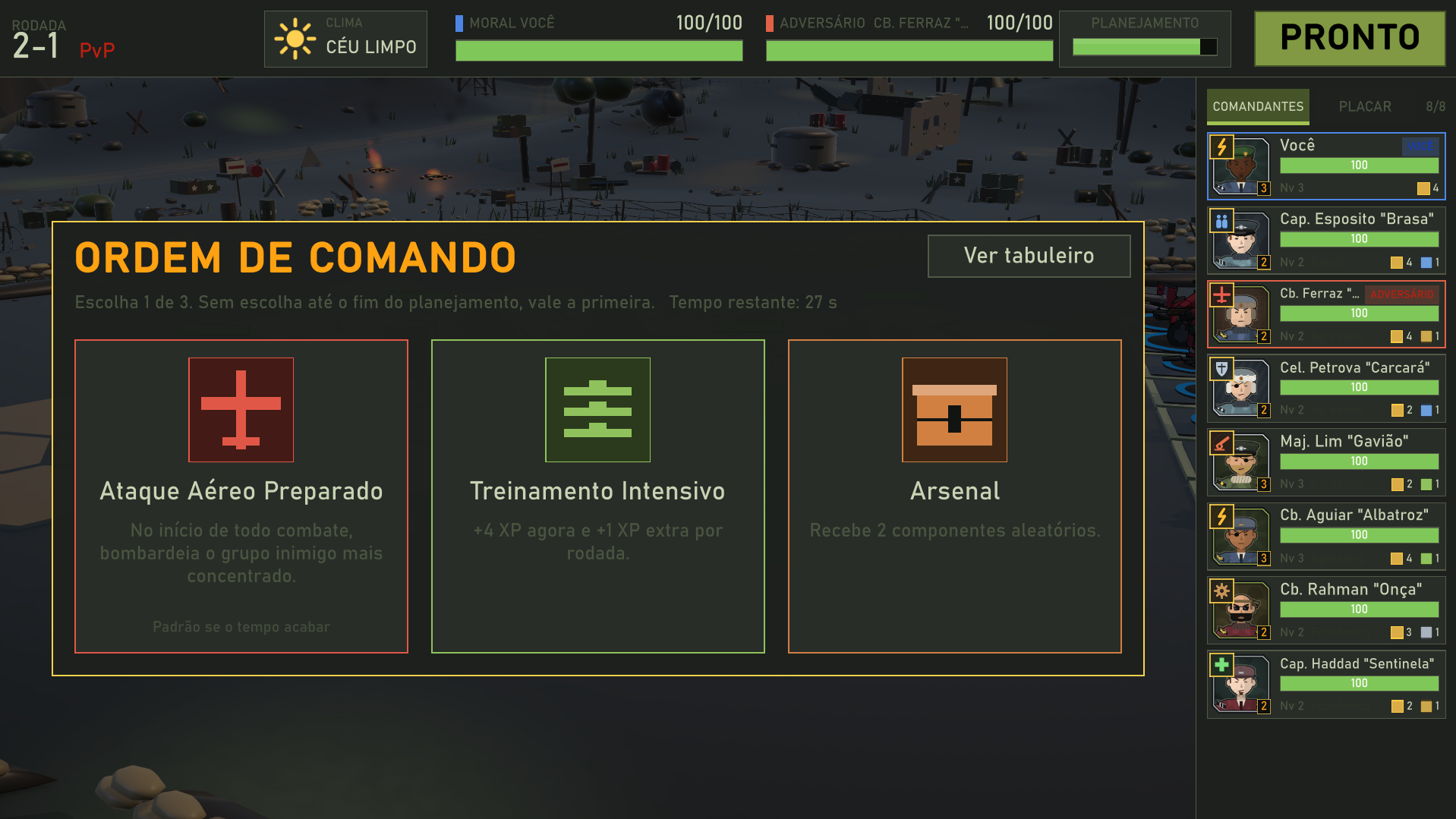
Prepared Air Strike bombs the most clustered enemy group every fight. Intensive Training speeds up your rank. Arsenal gives you 2 item components. If time runs out, the first one is picked.
Veterans
This is one of my favorites. A unit that's still alive on the field at the end of a fight gains experience and, over time, ranks up: Veteran, Elite and Legend, each with health and damage bonuses. They get chevrons above their health bar and, at Elite and Legend, extra details on the helmet.
The twist that gives it weight: selling the unit loses the rank. That Rifleman who's been with you since round one is now worth more than its card says.
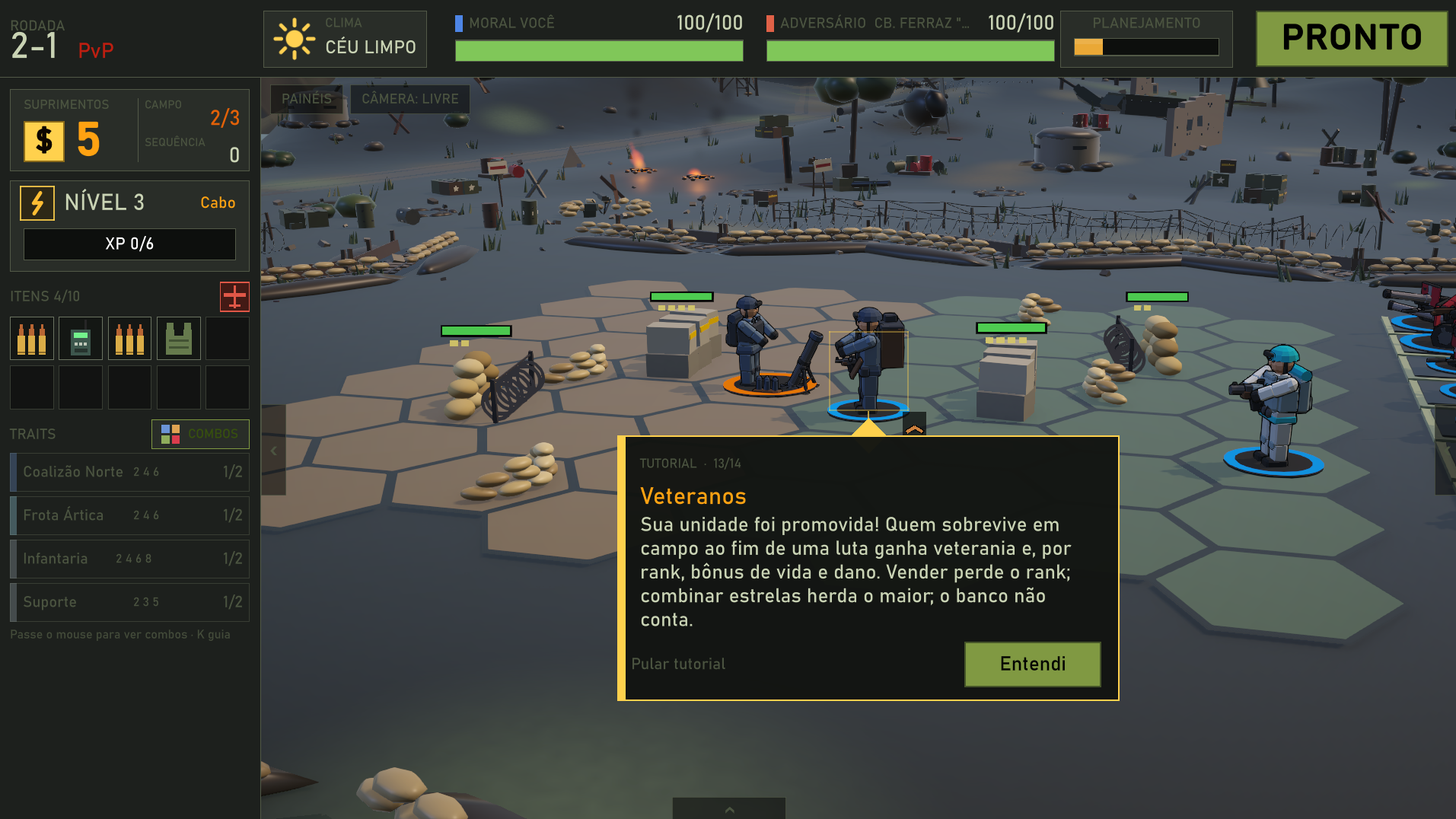
The tutorial tip shows up on your first promotion. Check the left panel: Corporal rank, 4 items in the inventory and the active traits, with each one's breakpoints.
Under the hood
One decision I made right at the start: the combat simulation is pure, deterministic C#, separate from Unity. Unity only draws what the simulation has already decided.
That brings some very practical benefits:
- Same seed, same fight. Always. There's an automated test making sure of it.
- I can run thousands of bot-only matches, without even opening Unity, to measure balance. Every new mechanic (weather, bombardments, veterans) only went in after running hundreds of matches with and without it and checking that no team style got too strong.
- All balance numbers live in JSON files, nothing hardcoded.
The unit models are built by script in Blender, with each Doctrine's colors, and ★2 and ★3 units get extra details.
Where it stands
Ironhex has gone through three milestones:
- M0, prototype: board, shop and 1 vs 1.
- M1, full loop: 8 commanders, 36 units, economy and ranks.
- M2, MVP: items, Command Orders, cover, art and audio. It closed with a playtest with friends, which validated the game.
After that came weather, generals, bombardments, veterans, a supply carousel and a 12-mission campaign across three theaters (Desert, Arctic and Jungle). The game is already in Portuguese and English.
The next step is Early Access on Steam, single-player only. Online multiplayer already has a working foundation, but it'll come later, once the game takes off or the community asks for it.
There's no public Steam page yet. When there is, I'll post it here.
Follow the development
I also post video content over there. Follow along:
- YouTube: @dev.gui01
- TikTok: @dev.gui1
If you're into auto battlers or military strategy, tell me what you'd like to see in the game. Every idea helps.
See you in the next one. 🎖️